
Shopify and WooCommerce are the two platforms we get asked about most when someone wants to open an online store. Both can run a serious shop. They work in very different ways, though, and the right choice depends less on features than on how you want to run the store day to day: who looks after the technical side, how much you need to customise, and how you prefer to pay for it.
This guide goes through the real pros and cons of each platform and ends with a simple checklist for choosing between them. Prices and fees are the published rates in September 2026, and where it helps we add what changes for a business based in Malta.
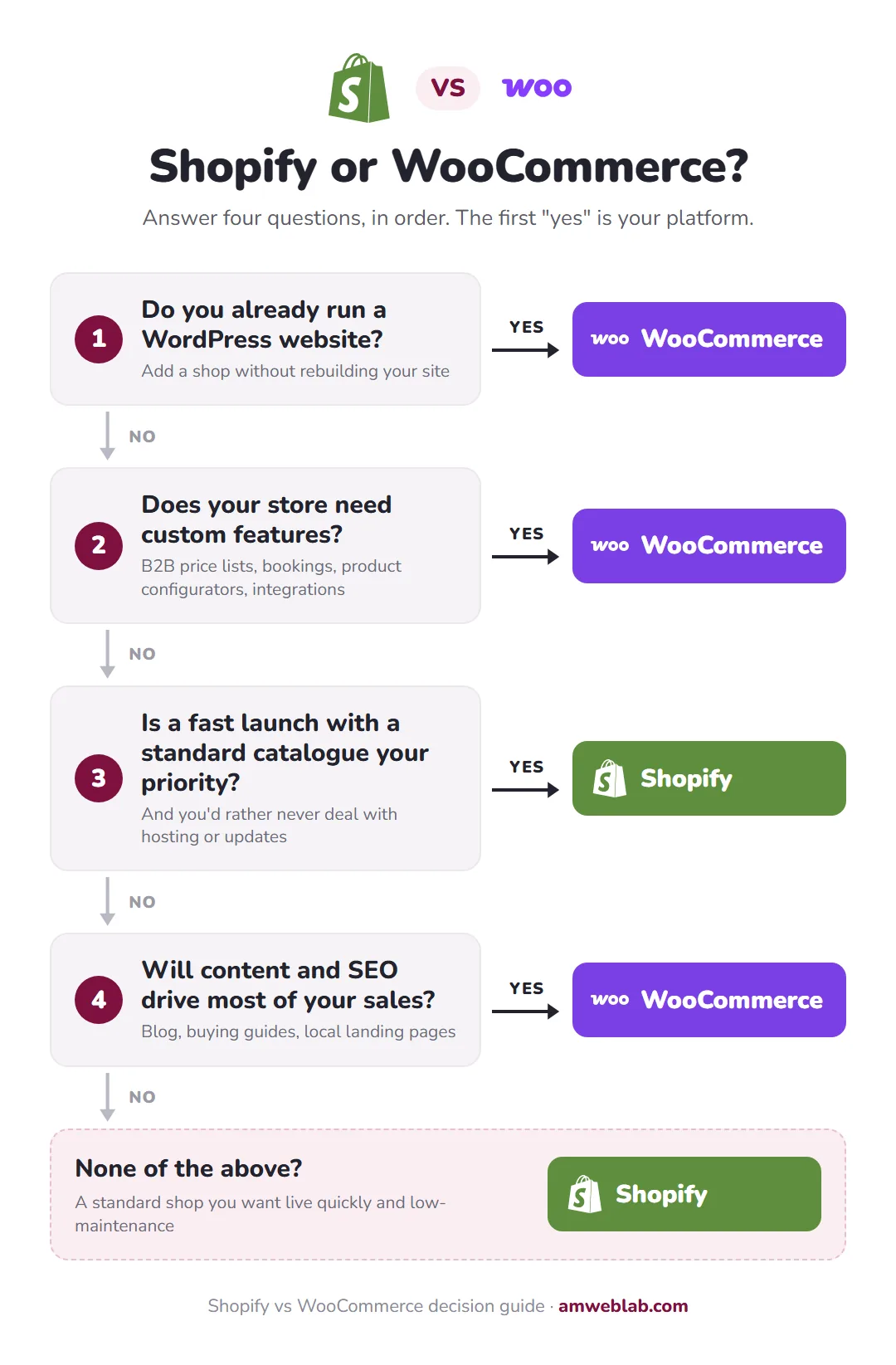
The short answer: choose Shopify if you want to launch quickly and never think about hosting, updates or security. Choose WooCommerce if you need custom features, already have a WordPress website, or want to own your store and your data outright.
Shopify is a hosted platform. You pay a monthly subscription and Shopify runs everything behind the store: servers, security, updates and checkout. You manage products and orders from a dashboard and extend the store with apps from the Shopify App Store.
WooCommerce is a free, open-source plugin for WordPress. You install it on your own WordPress website, on hosting you choose and pay for. You have access to all the code and the database, and you extend the store with plugins. In exchange, somebody has to look after hosting, updates, backups and security: you, or the developer you work with.
Almost every pro and con below comes back to this. Shopify is like renting a fully serviced unit in a shopping mall. WooCommerce is like owning the building.
| Shopify | WooCommerce | |
|---|---|---|
| What it is | Hosted, subscription platform | Free plugin for WordPress, self-hosted |
| Platform cost | Monthly plan, from €29/month (€22/month billed yearly) | Free, plus hosting and any paid extensions |
| Fees on sales | Card fees with Shopify Payments; an extra 0.2% to 2% if you use another provider | Only your payment provider's fees |
| Hosting and updates | Included and managed by Shopify | Your responsibility (or your developer's) |
| Customisation | Good within the limits of themes and apps | Practically unlimited |
| Extensions | Over 16,000 apps, many with monthly fees | The WordPress plugin library plus paid WooCommerce extensions |
| Ownership | Data exportable; theme and apps stay on Shopify | You own code, data and hosting |
| Best for | Standard catalogues, quick launch, low maintenance | Custom features, content-led stores, existing WordPress sites |
Comparing the headline price is misleading, because the two platforms charge in different places.
Shopify shows prices by country. A visitor from Malta sees these plans (September 2026):
On top of the plan you pay card fees (with Shopify Payments, online card rates start at 1.7% + €0.25 on Basic and go down on higher plans), paid apps and, if you want one, a premium theme. The current figures are on the Shopify pricing page.
WooCommerce costs nothing to install, but you pay for hosting, a domain, any paid extensions and the payment provider. Stripe, for example, charges 1.5% + €0.25 for standard European cards in Malta, and nothing goes to WooCommerce. The biggest cost is often maintenance: either your own time or a monthly care plan with a developer.
For a small store with a standard catalogue, Shopify is often cheaper in the first year, because there is less to build. For a store with custom needs, WooCommerce usually costs less over time, because you do not pay for features through monthly apps and higher plans.
Both platforms work well for a business registered in Malta. On Shopify, Shopify Payments is the natural choice because it avoids the extra transaction fee. You can still use PayPal alongside it, and many shoppers expect to see it.
On WooCommerce you are free to pick: Stripe, PayPal, WooPayments (which supports Malta) or one of the licensed local payment companies, which often work on custom pricing for higher volumes. There is no platform fee, whichever you choose.
VAT: Shopify can calculate EU VAT automatically and lets you add your OSS number if you sell to consumers in other EU countries. Shopify Tax is free up to €100,000 in sales, then charges a small fee per order. It calculates and collects the tax, but it does not file your VAT returns: that stays your job or your accountant's. WooCommerce has built-in tax tables where you set the rates yourself (18% is the standard rate in Malta), or you can add a tax plugin. Either way, check with your accountant whether you need to charge VAT and when OSS applies to you.
Shipping: neither platform has an official MaltaPost integration, so shipping rates for Malta and Gozo are usually set up by hand. WooCommerce shipping zones can match postcodes out of the box, which makes a separate Gozo rate easy. Shopify offers local delivery by postcode or distance from your shop. For collection points, MaltaPost's Easipik lockers can be offered as a delivery option on both platforms.
Yes. Google does not favour one platform over the other, and stores on both rank well. The difference is how much control you get.
Shopify covers the basics out of the box: editable titles and meta descriptions, a sitemap, canonical tags and mobile-friendly themes. Its URL structure is fixed, though: products always sit under /products/ and categories under /collections/, and you cannot change that.
WooCommerce, with WordPress and an SEO plugin, lets you control URLs, structured data, category pages and blog content in detail. That matters most for stores that want to win organic traffic with content, such as buying guides, comparisons and local landing pages. In both cases the platform only sets the ceiling. Speed, product descriptions, category content and links decide whether you actually reach it, which is the work we do with SEO in Malta.
The decision guide below sums up the choice in four questions. The two checklists after it go into more detail.
Shopify is usually the better fit when:
If this sounds like your business, have a look at how we work as a Shopify developer in Malta.
WooCommerce is usually the better fit when:
A typical case in Malta: a wholesaler in Qormi who wants trade customers to log in and see their own prices, while retail customers see the public ones. Shopify now offers B2B features on every plan, but below Plus you are limited to three price lists. On WooCommerce there is no such limit, and the logic can be shaped around how the business already works. More about how we build these stores on our page on WooCommerce development in Malta.
Yes, in both directions, but it is never a click. Shopify lets you export products, customers and orders as CSV files, and WooCommerce exports products natively, with orders and customers usually moved through an extension or a migration tool. What does not move is the design: a Shopify theme does not work on WordPress, and vice versa, so switching means rebuilding the front end.
The part people forget is SEO. Shopify and WooCommerce use different URL structures, so every product and category page needs a 301 redirect from the old address to the new one. Skip that and the store loses the rankings it has built. If you think you might outgrow your first platform, it is worth planning for it from the start.
There is no winner in general, only a better fit for a specific business. For a small shop with a standard catalogue and no appetite for technical work, Shopify is hard to beat. For a business that needs custom features, lives on content, or already runs on WordPress, WooCommerce usually gives more for less over the years.
If you are still unsure, write down three things before you decide: what you sell and how many products you have, what the store must do that a standard shop does not, and who will look after it once it is live. The answer is usually clear after that. And if you are just getting started, our complete guide to selling online in Malta covers everything that comes before the platform: registration, VAT, payment provider fees and shipping.
For a small store with standard products, Shopify is often cheaper in the first year because there is less to build. Over time, paid apps, higher plans and extra transaction fees can make it the more expensive option, while a WooCommerce store's costs are mostly hosting, maintenance and any paid extensions.
No. WooCommerce takes no cut of your sales. You only pay the fees of the payment provider you choose, such as Stripe, PayPal or WooPayments.
Yes, businesses based in Malta can use Shopify Payments for online sales. Shopify's own card readers and Tap to Pay for in-store payments are not offered in Malta, so a physical shop needs a separate card terminal.
Both can rank well. WooCommerce gives more control over URLs, structured data and content, which helps stores that rely on organic traffic. Shopify covers the essentials out of the box but has a fixed URL structure. Content, speed and links matter more than the platform.
Yes. Products, customers and orders can be exported and imported, but the design has to be rebuilt and every old URL needs a 301 redirect to its new address to keep your Google rankings.
If you want to launch quickly, sell standard products and avoid technical work, Shopify is usually the easier start. If you already have a WordPress website or need features a standard shop does not offer, WooCommerce is usually the better long-term choice.
Not sure which platform fits your business? Take a look at our ecommerce development in Malta services or get in touch: tell us what you sell and we will tell you honestly which platform we would choose, and why.